
Giddy Up, Planet Earth 🐴
The Wood Snake reshaped the world quietly. Now the Fire Horse is running. Here's what that means for the energy transition.

Last year was the Year of the Wood Snake. Patient. Strategic. Shedding its skin. The kind of energy that doesn't announce itself at parties but somehow rearranges all the furniture while everyone's asleep.
Seems like a decent metaphor for what actually happened.
In 2025, China installed 260 gigawatts of solar (more than the entire accumulated solar capacity of the United States — yes, the whole thing), along with 75 GW of wind, nearly 30 GW of battery storage, and four new nuclear reactors. Electric vehicles crossed 50% of new car sales. The result was extraordinary: China's greenhouse gas emissions plateaued. The economy kept growing. Clean energy simply grew fast enough to absorb all new electricity demand.
Australia crossed 50% renewable generation in its national grid, with wholesale electricity prices falling 44% year-on-year. Global clean energy investment hit a record $2.3 trillion. India began building its industrial future directly on solar and storage, potentially leapfrogging the dirtiest chapters of development entirely.
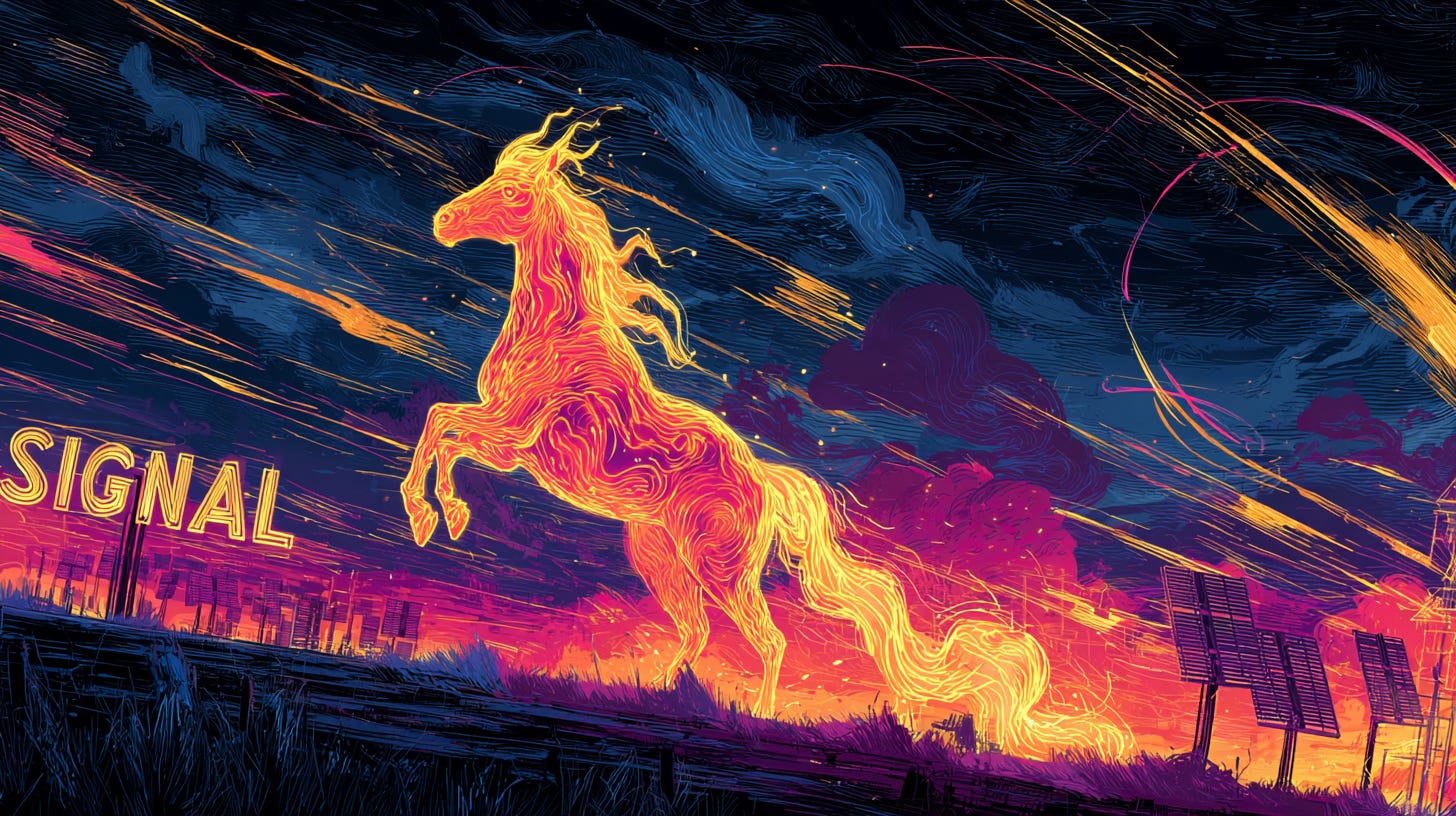
The Snake did its work. We shed a lot of baggage last year, overcoming some pretty sizable obstacles. Yeah, some new ones arose. Some snakes are still clinging to their old skins and it's pretty ugly. But now we're in the Year of the Fire Horse. Buckle up.
If the Snake was about quiet transformation, the Horse is about what comes next: speed, power, hooves-on-the-ground, electric-powered forward motion. Danny Kennedy captures it perfectly in his ProElectrica newsletter: this is the year momentum becomes a force to behold. China is on track for another 265 GW of solar and 120 GW of wind in 2026 alone. The structural economics are locked in. Solar, wind, and batteries are now the cheapest way to build new power almost everywhere on earth.
The Horse has already left the barn — we're just trying to keep up.
But Danny's deeper point is worth sitting with. Technology, capital, and physics are no longer the binding constraints on the transition. Those problems are being solved. The real constraint is imagination. What we need now is to match that momentum with better markets, more installers, smarter grids, and stories that unlock more people to act. Less doom-scrolling, more doing.

Peter McKillop raises a harder geopolitical question in Climate & Capital, drawing on historian Adam Tooze: China may be the only country that has actually built the industrial machine to scale clean energy at the speed the planet needs. Tooze calls it like watching the pyramids being built. The risk is that Washington's instinct to contain China as a rival, rather than engage it as a central player, becomes a climate liability in itself. Throttling the world's largest clean-tech manufacturing base and winning the climate fight are goals that pull in opposite directions. Even the panda thinks that's a bad trade.
The Snake laid the groundwork. The Horse is running on cost curves, capital flows, and compound growth. The physics are aligned. The money is aligned. The question is whether policy and imagination align fast enough to meet them. We are no longer debating whether the transition can happen. We are deciding how fast we allow it to.
There is chaos in the energy of the Horse. There is acceleration. There is friction. We are living through the moment when the economics flipped and the consequences begin compounding. Interesting times, yes. Also decisive ones.
The Million View Club
This video recently hit 1 million views on our Urdu channel. Pakistan is making a massive leap in renewable energy, with solar power now providing 25% of the country's electricity and plans underway for a major solar panel factory to eliminate long-standing power shortages.
Yippee Ki-yay!
In this week's Signal meditation, we ride the Fire Horse into the future.